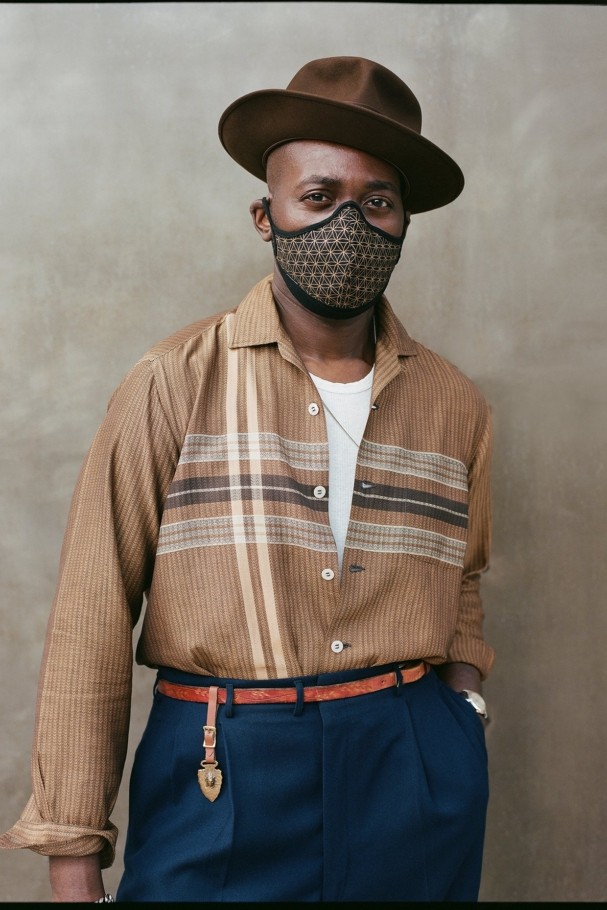
Editorial, Fashion & Style:
Lisa Kato Face masks for the new normal for Clutch mag.
Lisa Kato Face masks for the new normal for Clutch mag.
By: Mustafa Ali-Smith
Cover Photo: Gioncarlo Valentine
March 23, 2026
Mustafa: For People who might be discovering you or coming across your work for the first time — Could you introduce yourself and describe your practice?
Niama: I am a New York-based multidisciplinary artist, educator, curator, organizer, and producer. The phrase I’ve landed on is change agent — it captures the way my work moves across realms and disciplines. Everything I do explores the human story through the lenses of culture, history, music, race, and ritual. Whether I’m performing, exhibiting, or writing catalog essays for artists I’ve collaborated with for nearly a decade, the throughline is the same: leveraging history — the visual, the sonic and the written word, the ephemeral — to tell stories we already know in ways we haven’t yet thought to tell them. Together with artists in my curatorial work, in other collaborations, and in my own practice, the goal is to let the work speak in ways that open up different conversations.
Mustafa: When I look at your practice, I’m hearing race, history, memory — what Toni Morrison called Rememory. How did you arrive at that particular convergence? How did you become someone whose work lives at that intersection?
Niama: It started early — music was the first thing I knew I could do, around age three or four. I grew up in New York attending magnet schools, first Philippa Schuyler, then Brooklyn Tech, where my major was media communications at fifteen or sixteen. Cultural immersion was always part of my formation. My father’s family was involved with the Brooklyn Labor Day masquerade — the West Indian parade — and I literally grew up on Rockaway Parkway where the parade begins. I was watching that living cultural exhibition out my window every September without yet having language for what it was.
After attending Howard University later on, I ended up working in public school administration in D.C.— and it became clear that wasn’t the way forward. My father had passed, I was in my mid-twenties, and I asked myself: what have you always gravitated toward? History was the honest answer. I applied to graduate school at SOAS in London — with no plan, no funding — and got my acceptance the day I was leaving Trinidad after Carnival. My dissertation won best in the entire anthropology department. I came back to New York in 2013, and in 2014 developed my first curatorial proposal — Black Magic: AfroPasts/AfroFutures — before Afrofuturism had entered mainstream conversation the way it did with Black Panther and everything that followed. The shows opened in New York and Washington, D.C. in 2016 and 2017 respectively.
I used anthropology as a foundation for curatorial practice because I felt there wasn’t a dearth of Black art — there was a dearth of how it was being spoken about, how it was being contextualized. Content without context will get you further, but that’s never really been why I wanted to do this work. I have a saying: we’re all in the room, but we’re all in the room for different reasons. That’s where the rubber meets the road.
Mustafa: So that trajectory — the history, the anthropology, the curatorial work — brings us to right now, to Adorned Futures at FIT, and to the piece you have in the show. At Brooklyn Circus, a lot of what we talk about is future proof — how we lean into possibility, how we build toward futures that belong to us. When I look at your work in this exhibition, that’s exactly what I see. Can you tell us how you ended up here, and what this piece is really about?
Niama: It started with a vision, literally. In January of 2020, I finished an essay for Nate Lewis’s solo show — that show opened March 1st, 2020, just a week before everything changed. As I finished that essay, sitting in the chair I used to write in, I saw a form open in front of me in the room. I knew it wasn’t physically there, but I knew I was supposed to make it.
Before that, I’d written a piece for a project with artists Ivan Ford at the MCA Chicago — we were exploring the Epic of Gilgamesh through cyanotype works and poetry. In that essay, I described what I called a “tensorgetic space” — drawing on Edouard Glissant’s concept of “the abyss” and Christina Sharpe’s notion of “the hold” — as an expanse where every formation of blackness across time can exist. That was the seed of the form I later started seeing in visions.
By March 2021, I was in New Orleans and started making small studies — I’d never really painted before and yet it felt very natural. The form needed to be large scale. Within months, I had scaled it to six-by-six feet, and larger after that. I eventually also made 3D-printed sculptures of the form. People say it looks like the grooves of a record, which wasn’t exactly how I formulated it — but I find it useful. Dr. Kelli Morgan once broke down the lyrics of George Clinton’s “One Nation Under a Groove” in a live conversation, and I realized: there is a protective force that has prevented the complete collapse of Black life. That’s what the form holds — all the multitudes, everything that ever was, everything that is, everything that will be. If that’s what it contains, 1. ancestors are present, and 2. It’s also a portal.
And if it’s a portal, where does it go?
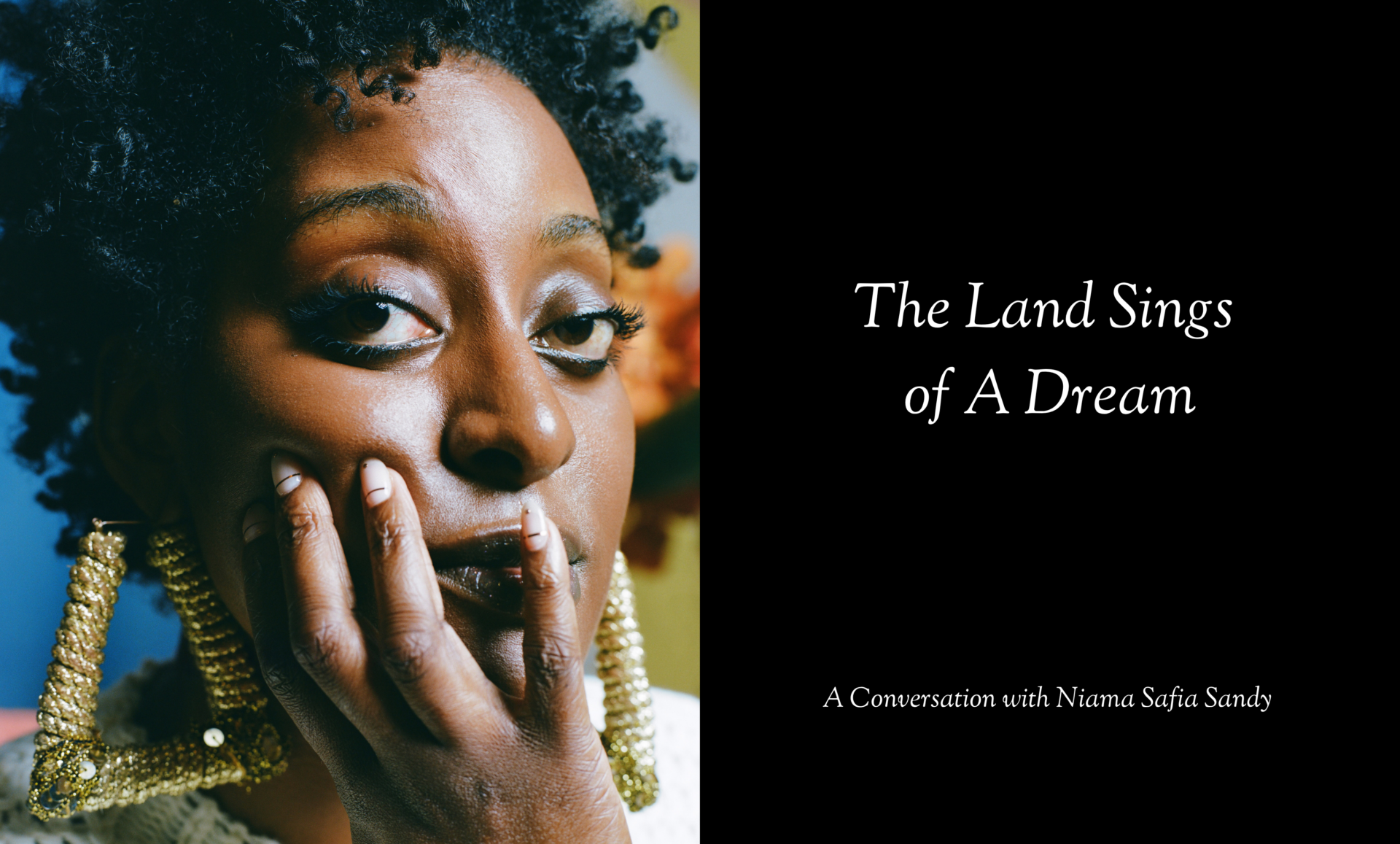
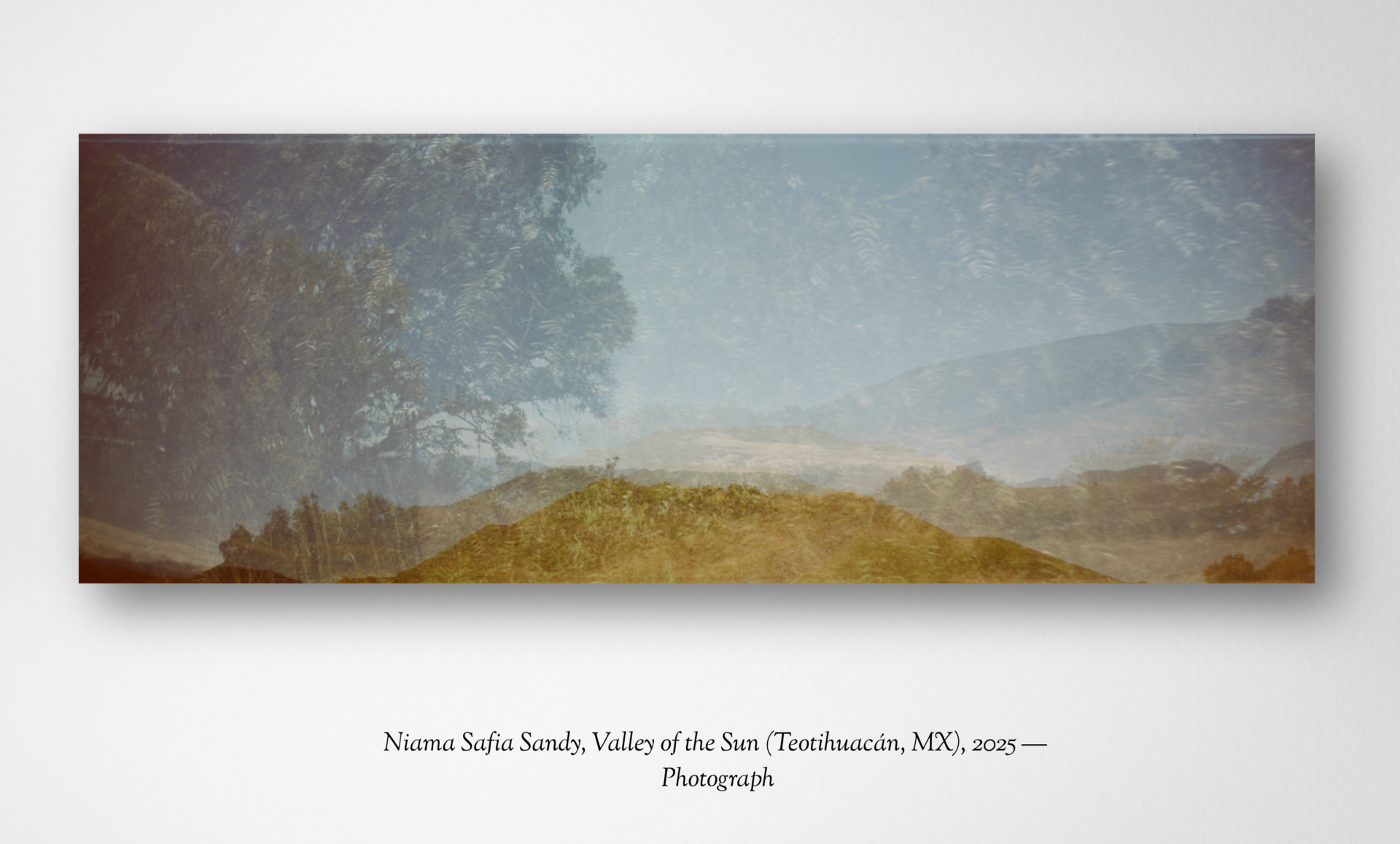
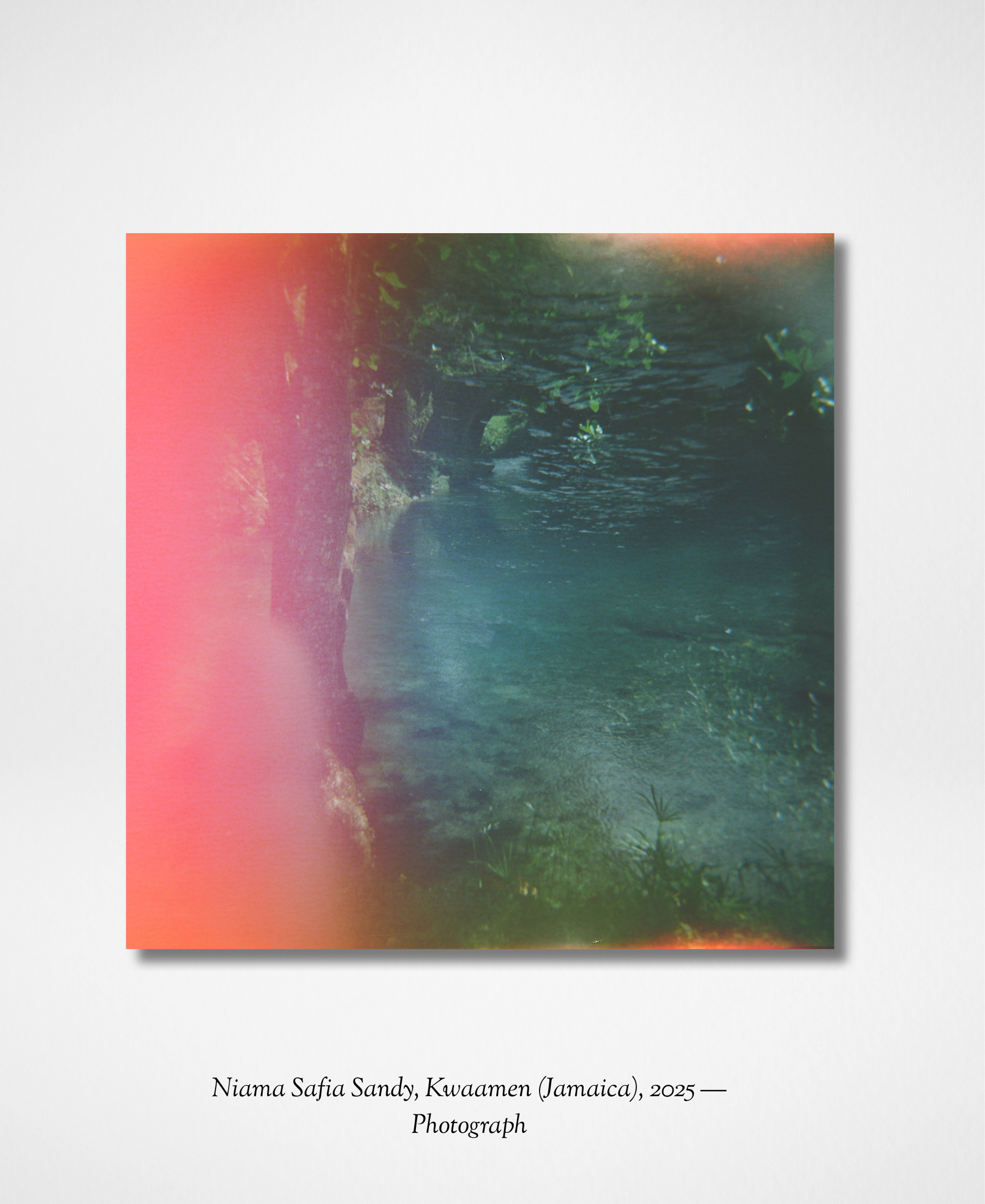
That question opened the larger body of work, which I call Genealogies of Sovereignty — thinking about specific historical moments when Black and Indigenous have people gathered and decided to assert their power. Founding towns, cultural revolutions, slave rebellions. I’m also invoking Saidiya Hartman’s ideas of “critical fabulation,” as a lot of this is me imagining a connection to those remnants of energy because the historical record is incomplete.The photographic series The Land Sings of A Dream grew from there. I began physically going to locations where these things happened, to create portals that put us in conversation with our ancestors’ energy, their fortitude, their courage.
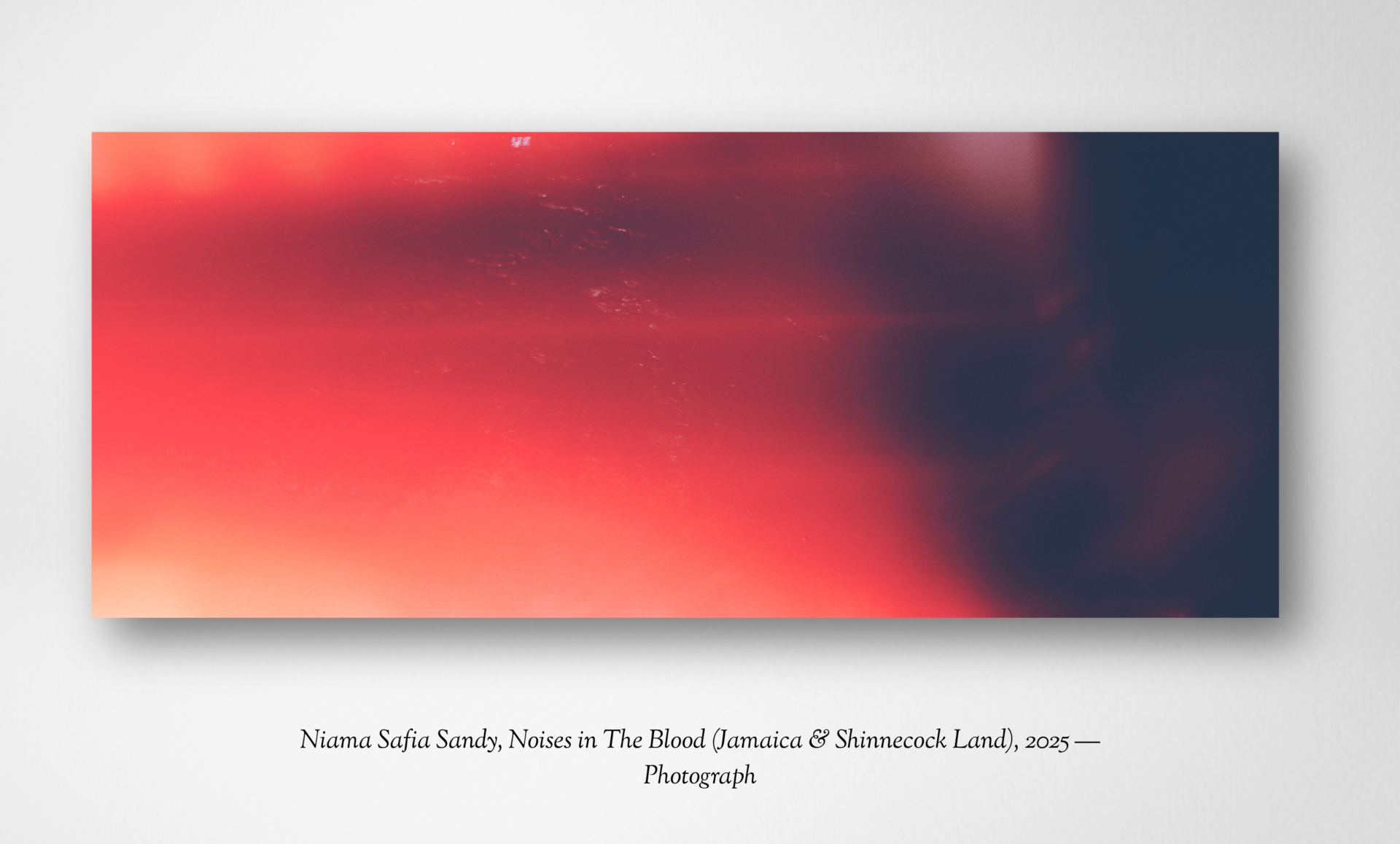
The work in Adorned Futures is called Noises in the Blood: Jamaica and Shinnecock Land. Last year I went to Jamaica for the first time. Jamaica has one of the highest numbers of slave rebellions on this side of the Atlantic. That energy is in the air, in the water. I took a seven-mile hike to a waterfall named for Kwame, a lieutenant in Tacky’s Rebellion of 1760 which went on for over a year. Even if the rebellion didn’t happen on that exact plot of land, there is something powerful in the fact that a physical place is still called by his name. Also, there is something remarkable about how pristine and untouched parts of Jamaica still are — that’s stewardship. That’s a form of resistance that deserves to be named.
I shot everything on analog cameras and kept all the film in the camera until I returned home for a residency at Ma’s House on Shinnecock Territory in Southampton, founded by Jeremy Dennis, one of the co-curators of Adorned Futures. It rained nearly the entire week. On the one clear day, I tried to shoot. We stopped at Cooper’s Beach, entering through a Shinnecock-only entrance, only to find people who were not Tribal members there. We moved to the bay beach, and found a yacht moored there, which also was not supposed to be. I worked anyway. That piece, for me, is about what it means to stand in opposition to those impositions — allowing the contested land to speak, literally contested in the very moment I was standing on it.
In this series overall, I consider the land itself speaking to a shared vision of a future free of oppression. Hence the title.
Mustafa: I love how you describe the process — the analog cameras, not knowing what you have until you develop the film. You use the word “experimental” to describe some of this work. What does experimentation actually look like for you, in terms of how you move through it?
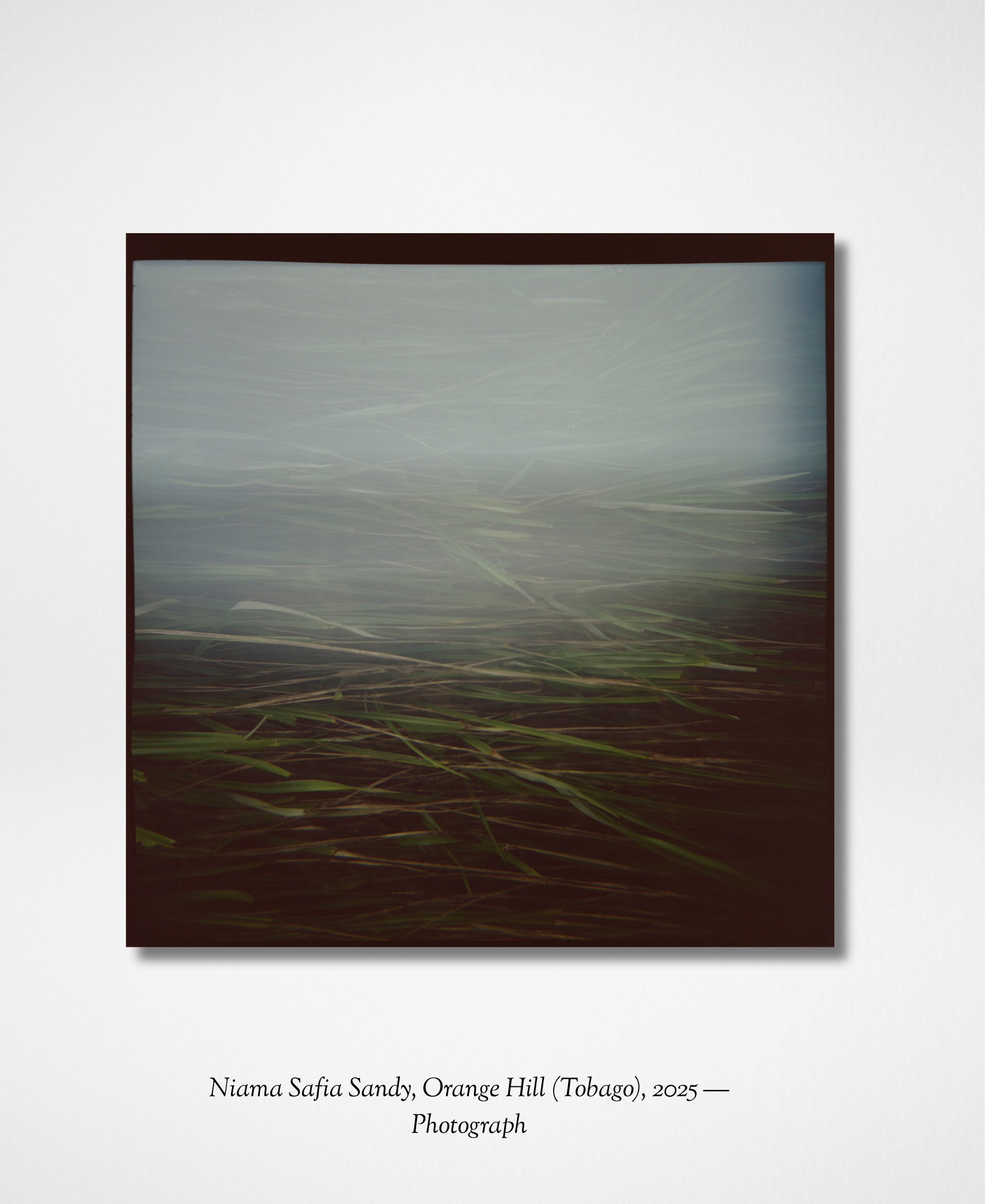
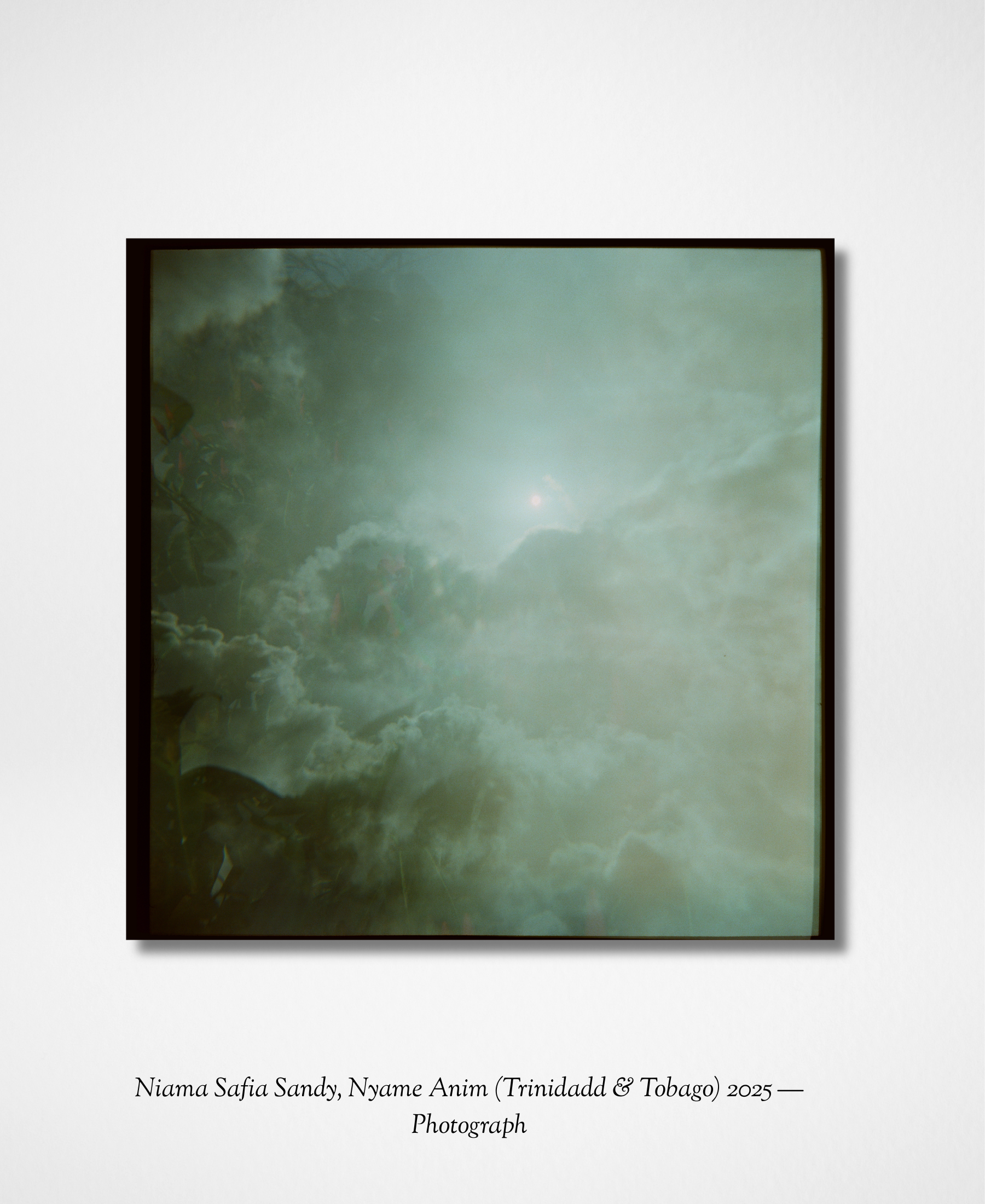
Niama: All of it is uncertain. I don’t know if the weather will cooperate, if the light will cooperate. It’s a fully analog process, so I have no idea how the images will look until after I develop them. Even after that there are still choices about scale, and substrates for printing and installation.
The work in the show is printed on cupro — a really lightweight, breathable fabric made from cotton scraps, meant to be environmentally sound. Printing the image on fabric gives it movement. I added grommets so it can be configured in different ways: hung vertically as it appears in Adorned Futures, horizontally, or in other ways that partially obscure the image. I’ve been thinking about Sam Gilliam’s practice — how he had a seamstress create seams and shapes within painted canvases — and that’s opened up new directions for where this can go.
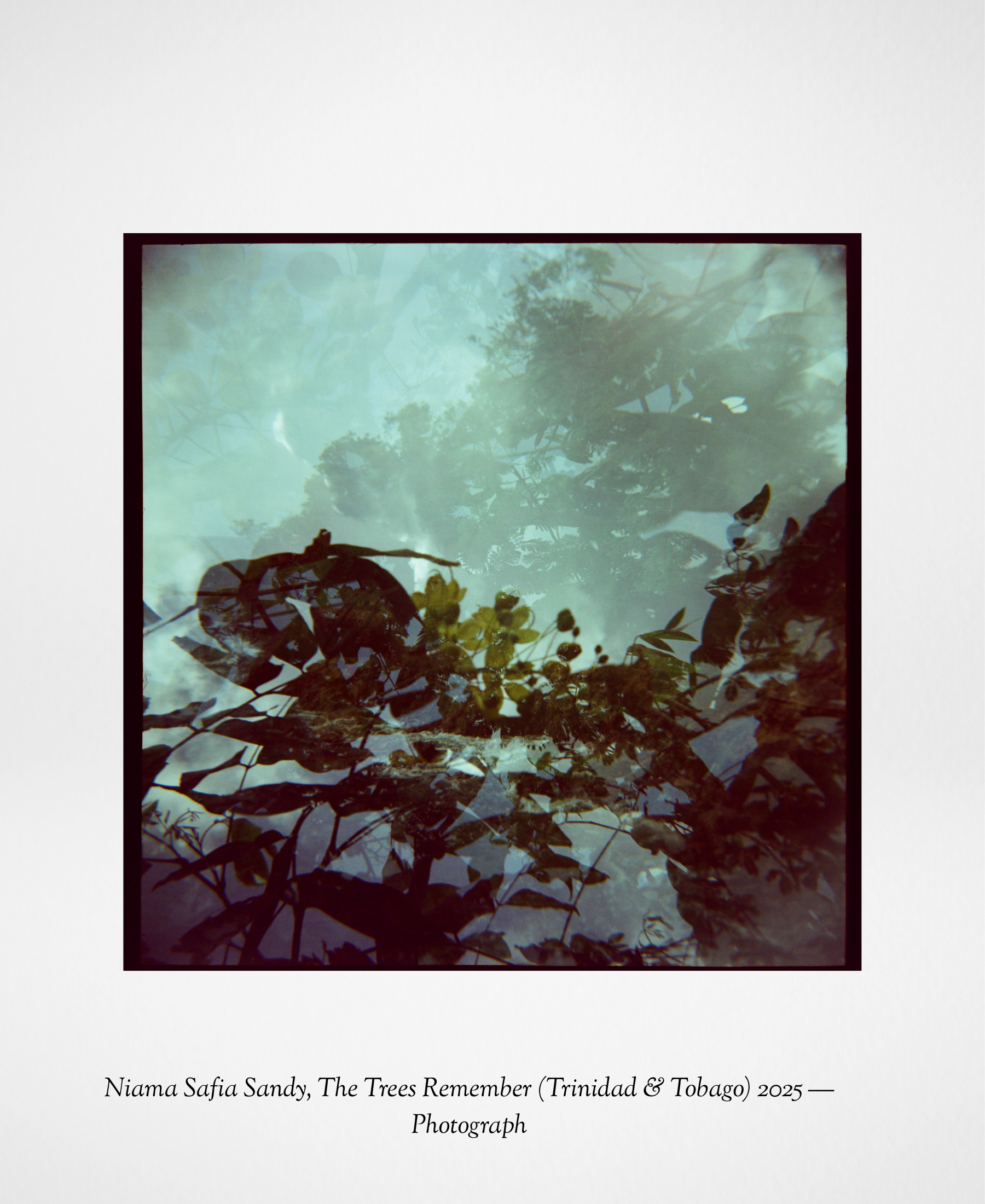
What I love most about these photographs is how painterly they are, without me necessarily intending that. They’re in context with nature, and with the idea of energy transmission being at the center of the image.
The experimentation isn’t about what you arrive at. It’s about embracing the process — the uncertainty — as part of the work itself.
Mustafa: I recently watched a Sun Ra documentary and there’s a line in the film that stuck with me: “If you’re not a myth, whose reality are you? And if you’re not a reality, whose myth are you?” The idea being that Black people should hold more myths about the futures we actually want. The Land Sings of A Dream feels like it’s in direct conversation with that. Whose futures are you imagining when you make this work?
Niama: My first exhibitions were called Black Magic: AfroPasts/ AfroFutures — very much engaging Afrofuturism not just as an aesthetic position, but as one oriented toward what arts administrator and artist, Desirée Gordon has called it “an ambulatory cosmology.” Thinking about the ways our technologies—the beliefs and culture we carry with us—have created pathways for us to still be here and thrive in the West. Whether that’s the Bantu knots I currently have in my hair, or the writing that will carry this interview forward. Technology doesn’t require advanced “Western” knowledge. Our traditions, our forms of cultural memory, our relationships to land — these are technologies too and have value.
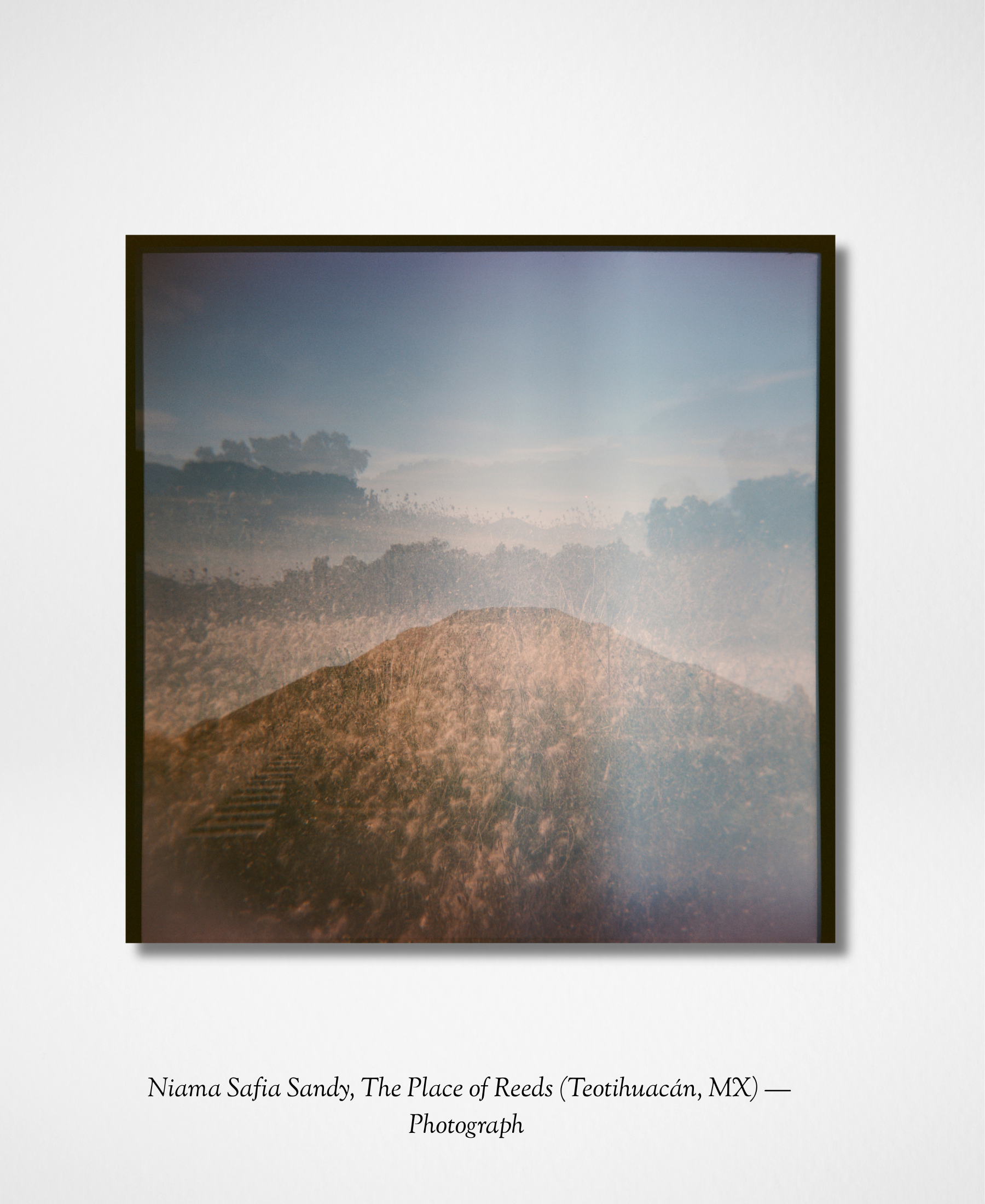
By going to these Indigenous and Black diasporic sites — in Jamaica, Shinnecock Land, Mexico, Trinidad, Senegal — I’m thinking about the futures of the global majority. The dream the land sings of is sovereignty. It’s freedom — a word that gets bandied about so much it can lose its edges, especially given what we’re watching happen politically right now. But this work has always been in opposition to forces that foreclose possibility.
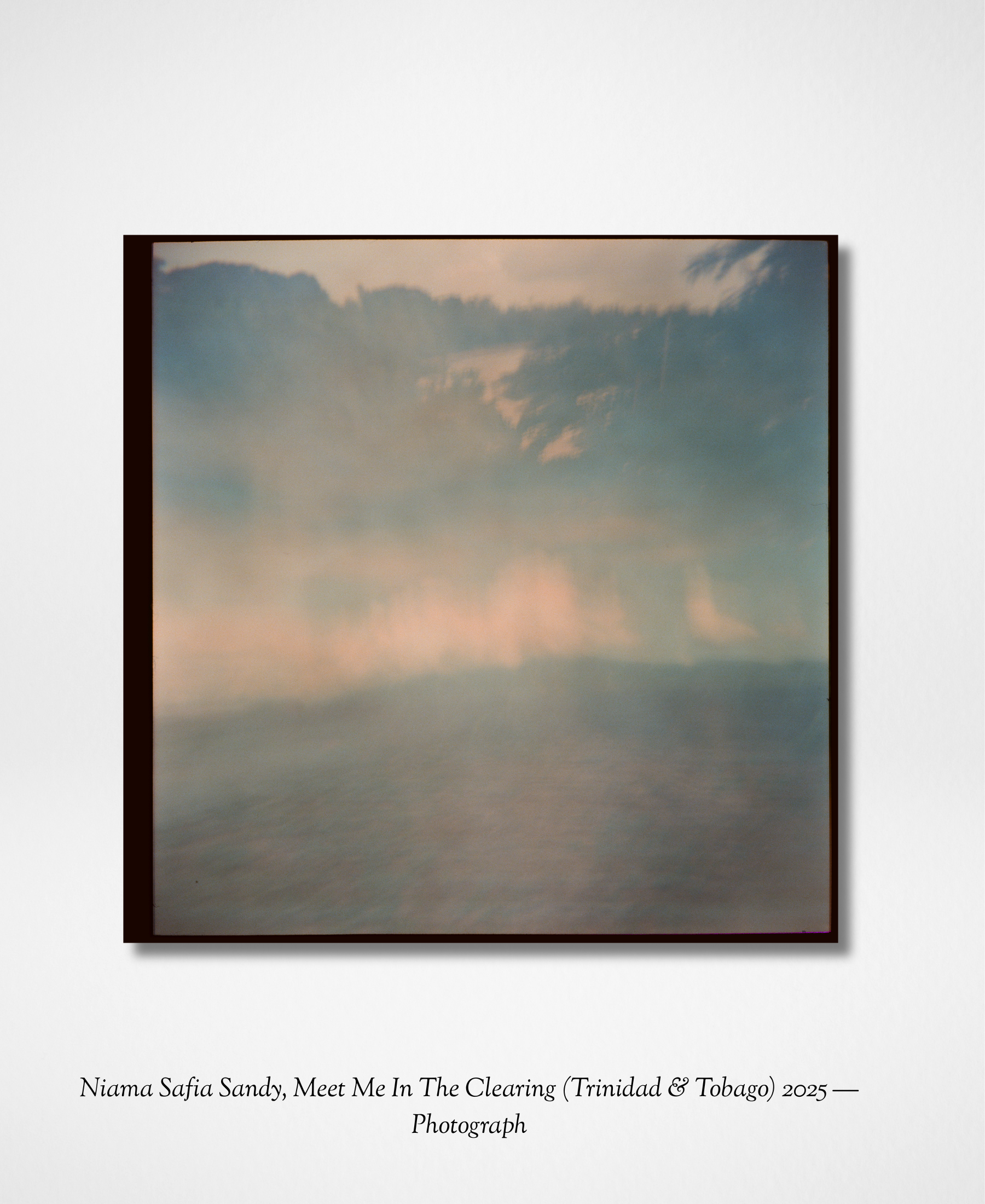
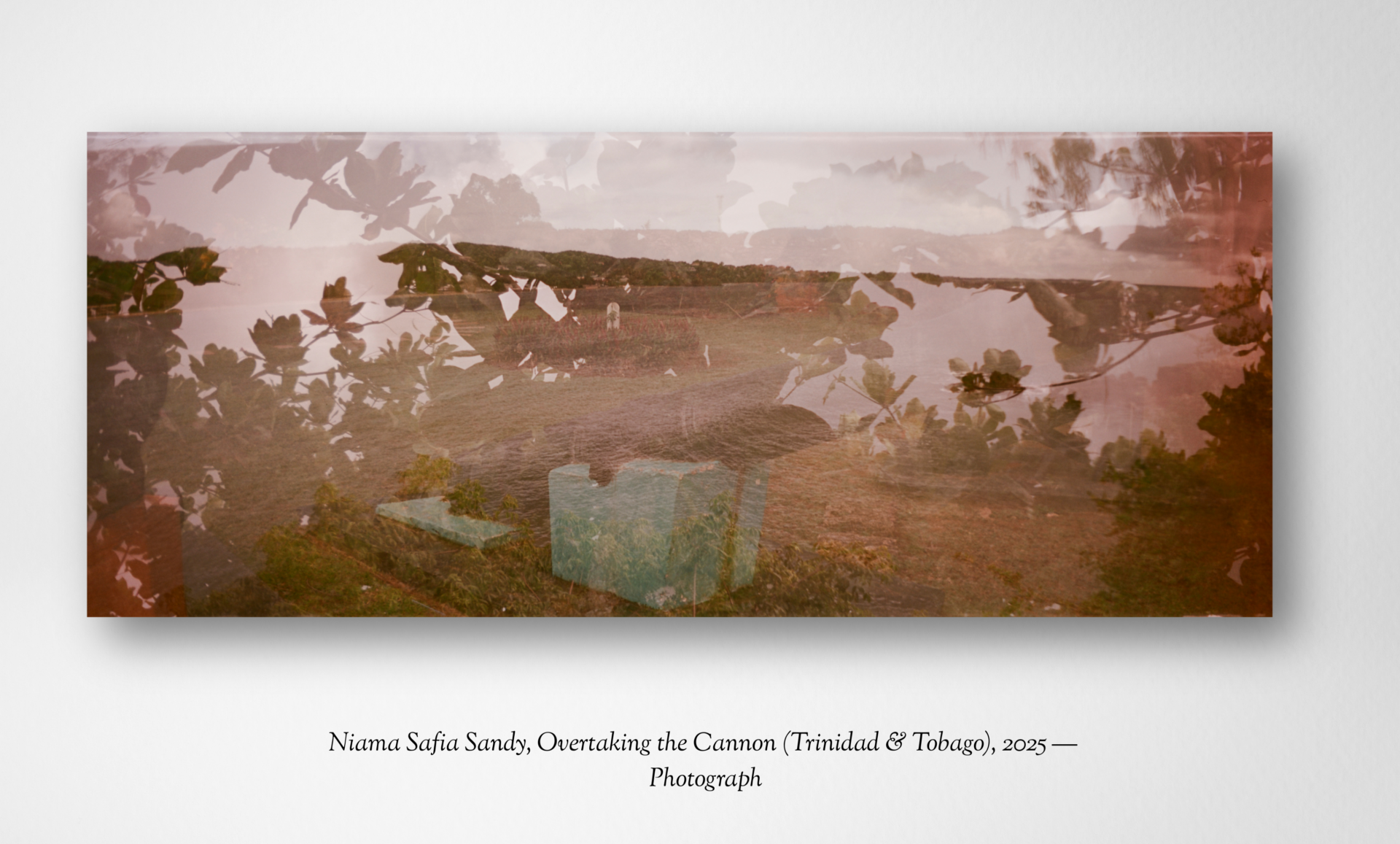
There’s another layer too. In the work in Trinidad I have retraced the steps of an ancestor of mine who started the first slave rebellion on record in Tobago in 1770. His name was Sandy, said to be an Akan chief. That rebellion happened on the Courland Bay estate and surrounding areas. It’s said he swam 25 nautical miles to Trinidad to escape capture. I’ve been to Fort James, Mount Irvine Tobago, in the Caribbean sea and in Trinidad making images imagining what he saw and what he did. Dr. Daniel Black has a theory that many successful slave rebellions were divinely inspired. I don’t disagree. I’m exploring that here as well. It makes a lot of sense because how else do you explain people who knew what failure meant, and did it anyway?
So I’m thinking about the past, our ancestors who made it possible for us to be here. I am positioning us for what I call “quantum replenishment,” calling in futures that act as repair for what has been lost.
Mustafa: Last question. Someone walks into Adorned Futures, they stand in front of your work — what do you want them to leave with?
Niama: I want them to know about possibility.
“Adorned Futures: Fabric, Form, and Indigenous Resistance” is on view at FIT through Sunday, March 29. The gallery is open daily from 9 a.m. to 5 p.m.
. . .
Niama Safia Sandy is a New York–based multidisciplinary artist, cultural anthropologist, curator, and educator. Her work explores culture, healing, history, migration, music, race, and ritual—using visual, written, and performative arts to tell familiar stories in transformative ways.
Her recent paintings and sculptures center a form she calls “The Groove,” a mathematical yet unquantifiable structure that resists the commodifying logics of whiteness and capitalism. Through it, Sandy engages time—past, present, and future—as a pathway toward balance, restoration, and freedom. Her artist residencies include The Last Resort Artist Retreat, The Watermill Center, 37d03d, and Ma’s House. She has taught at Columbia University, and Pratt Institute.
As a curator and producer, she has collaborated with artists and institutions including The Schomburg Center for Research in Black Culture, The Public Theater, and WinterJazzFest. She is a co-founder of THIS IS A MOVEMENT, an initiative advancing gender equity in Jazz and Creative Music through an intersectional Black feminist lens.
Instagram: @___niama___
www.niamasafiasandy.com